Recognizing Induction Pots: Why the Base Makes the Difference

Good pots are not simply replaced. They sit on the stove when things need to move quickly. When friends stay longer than planned. When a familiar recipe succeeds again and again - and a new one only develops its own character over time.

Over the years, cookware becomes an integral part of the kitchen. The weight feels familiar. The handles sit in your hand exactly as expected. Each pot has its place, its purpose, its story.

However, the key feature of a pot is not apparent at first glance. It is hidden where almost no one looks while cooking: in the base. It determines whether the cooktop recognizes the pot. Whether heat can be generated. Or whether the cooking zone stays silent. No hum. No heat. No response. The answer is surprisingly
simple. Often, a quick look at the underside or a small magnet is enough to know for sure within a few seconds.

A person in a dark apron holds two stacked Fissler stainless steel pots with lids, showcasing German quality in a simple, modern kitchen.

At a glance: How to identify induction cookware

Sometimes the answer is closer than you think. Right on the bottom of the pot. In a small symbol or in the simple reaction to a magnet.

Perform a magnet test

If a magnet sticks to the bottom, the pot is suitable for induction in most cases.

Check material

Magnetic stainless steel, cast iron, and enameled iron work on induction.

Check induction symbol

A spiral or coil on the base of the pan indicates
that it is suitable for induction.

Tip: If the symbol is missing, it’s worth reaching for a magnet. It often gives you certainty faster than searching through
old packaging, instructions, or manufacturer details.

How can you tell if a pot is induction-compatible?

An induction-compatible pot has a ferromagnetic base. It reacts to the cooktop’s magnetic field and generates heat exactly where it’s needed: in the cookware itself.

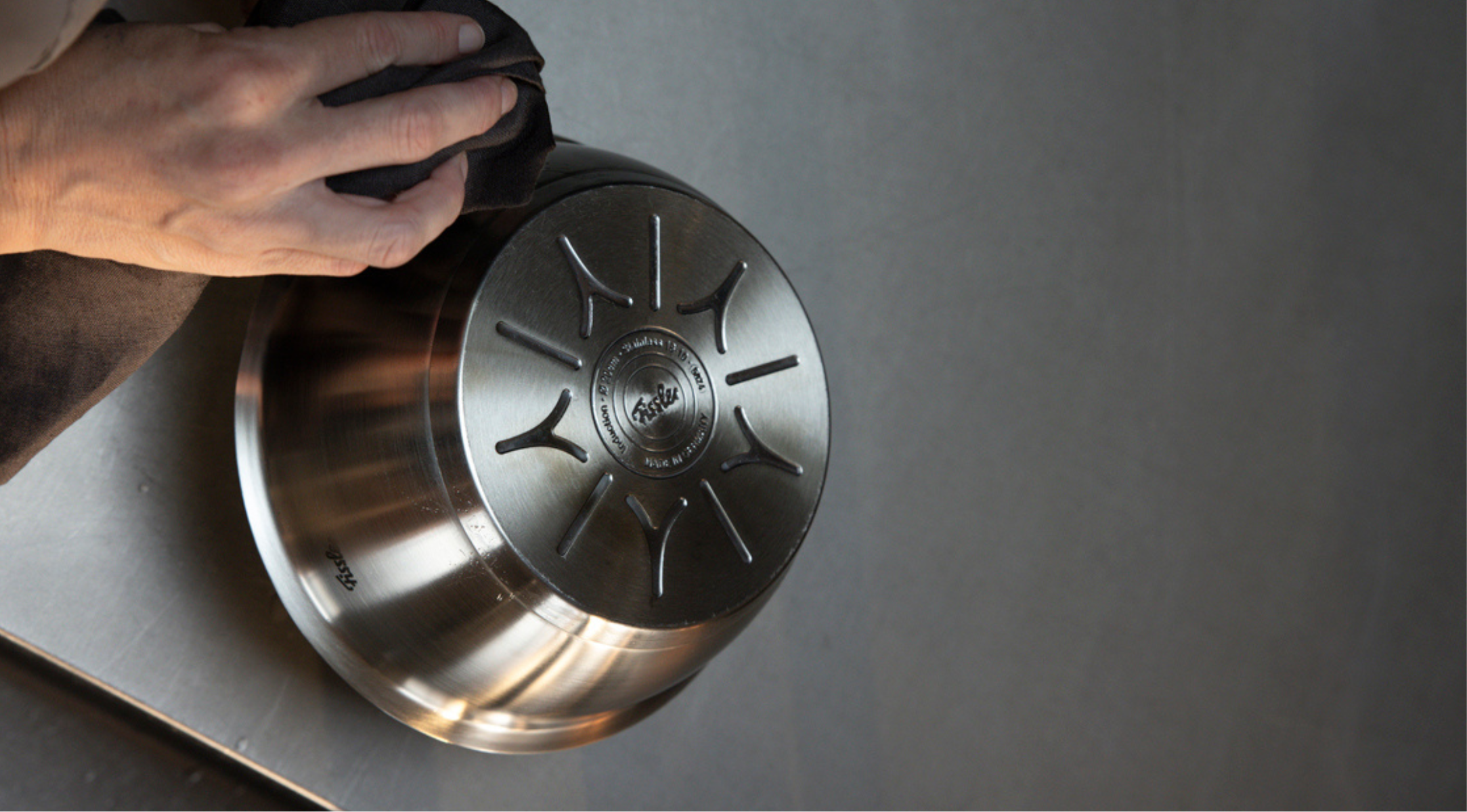
A hand uses a cloth to polish the base of a Fissler stainless steel bowl on a gray surface. The bowl features Fissler’s signature circular pattern and engraved logo, reflecting superior German engineering and timeless design.

From the outside, this feature is hardly noticeable. Stainless steel shines. The handles feel sturdy. The weight suggests durability. Two pots can look almost identical and still behave completely differently on an induction cooktop. 

If you want to identify induction pots, you should therefore look for four features:

  • The base of the pot is decisive. Only a ferromagnetic base reacts to the magnetic field and makes a pot suitable for induction. 
  • The induction symbol provides an initial clue. The coil or spiral on the base of the pot marks cookware that is suitable for induction. 
  • A magnet provides quick certainty. If it sticks to the base of the pot, in most cases that indicates an induction pot. 
  • The material also plays a role. Magnetic stainless steel, cast iron, and enameled iron are suitable for induction. Aluminum and copper only with a special induction base.


But even if a pot works on induction, that still says nothing about its quality. The real difference lies deeper in the construction of the base. 

It affects how evenly heat is distributed, how precisely temperatures can be controlled, and how pleasant a pot is to cook with in everyday use. Technology that does not push itself to the forefront. But instead ensures that good cooking feels completely natural.

A chef in a black jacket expertly drizzles sauce over a plated dish of vegetables and meat, using a spoon crafted from recycled stainless steel. Beside the chef on the stove is the Fissler M5 Pro-Ply® Stielkasserolle mit Metalldeckel—an induction-compatible saucepan renowned for its precision engineering, exceptional durability, and timeless German design.

The Magnet Test

A small magnet often says more than any product description

Sometimes it’s the simplest tests that give you the clearest answers. An ordinary household magnet is enough to find out within seconds whether a pot is basically suitable for induction. No specialist knowledge needed. No technical device. No lengthy reading. 

Hold the magnet against the underside of the pot base.

Magnet adheres

If it sticks clearly, the base has the necessary ferromagnetic property. In most cases, the pot is suitable for induction.

Magnet sticks weakly

The pot can often work as well. How reliably it is detected, however, depends on its construction and the specific hob.

Magnet falls off

A clear sign: the pot is not suitable for induction.

A chef in a white coat expertly sears a piece of meat using tongs in a premium Fissler stainless steel pan on the stove, while a matching Fissler pot and high-quality kitchen utensils, renowned for German precision and innovation, are arranged within reach.

Which material is suitable for induction?

Not every material reacts to a magnetic field. That is exactly why some pots are recognized by the cooktop immediately, while others stay cold despite the cooking zone being switched on. The material looks premium. The surface is flawless. But the base lacks the crucial magnetic property. 

In principle, the following materials and constructions are suitable:

Magnetic stainless steel

Ja

cast iron

Ja

enamelled iron

Ja

Multilayer material with ferromagnetic outer base

Ja

Aluminium

 For induction hobs only

copper

 Only with induction base

Glass

No

Many people are surprised that aluminium or copper alone do not work on an induction hob. After all, both materials are considered excellent conductors of heat. 

But induction asks a different question. Not: How well does a material conduct heat? But rather: Can it respond to a magnetic field? 

Pure aluminium and copper cannot do that. Only an additional magnetic layer built into the base turns them into induction-compatible cookware.

A person in a dark apron closes the lid of a Fissler stainless steel pressure cooker, highlighting German precision and craftsmanship.

Can induction pots also be used on other types of hobs?

Yes. An induction pot doesn’t just belong on an induction cooktop. It can also generally be used without any problems on ceramic, electric, and gas stoves. 

The magnetic base is only needed for cooking on induction. On all other types of stoves, the heat reaches the pot as usual via the cooking surface or the flame. The only thing that matters is that the cookware is suitable for the respective type of stove.

Ceramic glass and electric stove

On ceramic and electric hobs, induction pots work without restriction. A clean, flat base ensures that heat is absorbed evenly—quietly, reliably, and exactly where you need it.

Gas stove

Induction pots can be used on a gas stove without any problems. If the flame surrounds the base of the pot without rising up the sides, the heat is transferred efficiently into the cookware while also protecting the material and surface.

product knowledge

More inspiration & tips from the pro kitchen

Become a master at your stove and discover the versatility of uncoated stainless steel. We share our best kitchen secrets, product know-how, and inspiration for real craftsmanship in cooking with you.